- Developer
- Noodlecake
- Installs
- 1M+
- Downloads
- 0
- Views
- 1
- Updated
- Nov 6, 2026
Screenshots
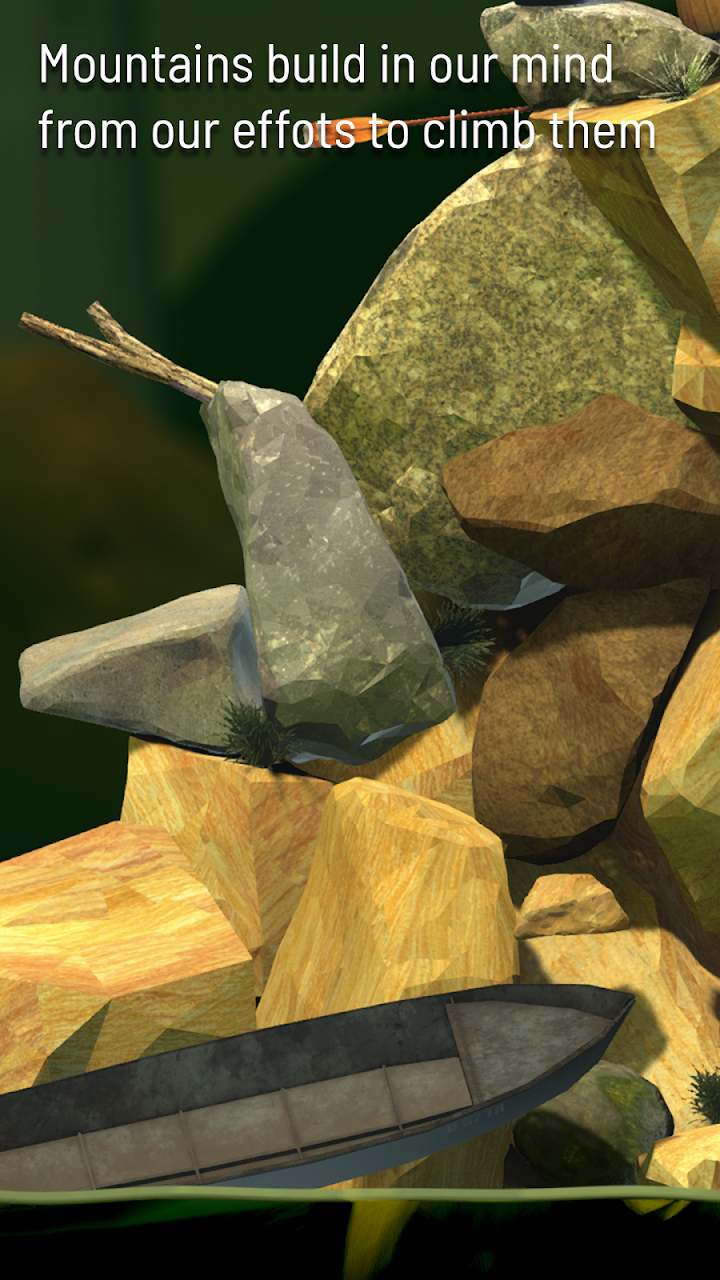
About Getting Over It
Getting Over It on Mobile: Same Mountain, Worse Odds
Updated November 2026 · Written by the NovaRunway editorial team
Quick Verdict
Getting Over It with Bennett Foddy is not a difficult game in the way most difficult games are difficult. There are no enemies, no timers, no health bar and no fail state. There is a man in a pot, a hammer, and a mountain. Your only input is the angle and motion of the hammer, and everything else — climbing, swinging, launching yourself across gaps — is an emergent consequence of physics. The design's cruelty is that a single mistake can cost you an hour of progress, and the game will not stop you from making it. On mobile, the port is faithful, the narration is intact, and the price is a one-time purchase with no ads or microtransactions. But it is also the hardest version of the game, because the mouse precision the original was designed around does not map cleanly to a thumb. If you have a controller, use it. If you have a tablet, use that. If you only have a phone and no patience, this is the version most likely to defeat you.
What Getting Over It Actually Is
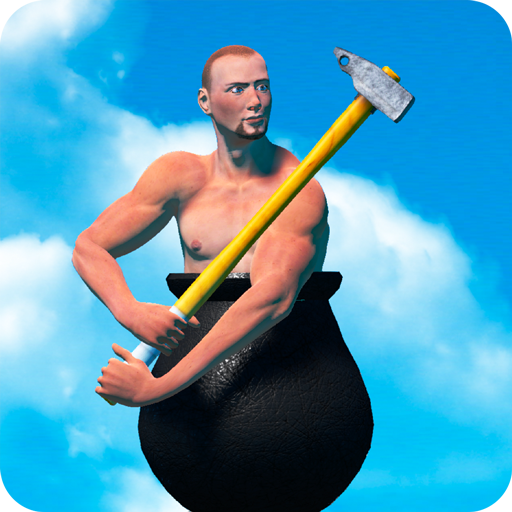
Getting Over It with Bennett Foddy is a physics-based climbing game released on desktop in 2017 and later ported to mobile. You control a man named Diogenes — a naked figure from the waist up, sitting in a cauldron, holding a Yosemite hammer — and you use that hammer to drag, hook, push and catapult yourself up a mountain of accumulated junk.
That is the entire game. There is no combat, no inventory, no upgrade system, no collectibles worth mentioning and no narrative branching. The hammer is your only interface with the world, and every movement is a physics interaction between the hammer's head and the surface it touches.
The game is explicitly a homage to Jazzuo's 2002 “B-Game” Sexy Hiking, a deliberately janky freeware climbing game with the same control conceit. Foddy's version takes that idea and builds a properly tuned physics engine and a mountain around it, then wraps the whole thing in narration about failure, frustration and the value of difficult things. The store description's line — “a game I made for a certain kind of person, to hurt them” — is not false advertising. It is a statement of design intent.
It is a premium one-time purchase with no adverts, no in-app purchases and no energy systems. It plays offline. The mobile port keeps the original narration intact, including the philosophical asides that play when you fall a long way, which is either the game's best feature or its cruellest joke, depending on how the last ten minutes went.
The Hammer, and Why the Controls Are the Whole Game
Most writing about Getting Over It describes it as “hard,” which is accurate but unhelpful. The more useful description is that it is a precision input game disguised as a climbing game.
The hammer has a head and a shaft. You control the angle of the shaft and the position of the head. The head collides with geometry. Push against a surface and the man in the pot moves. Hook the head over a ledge and you can pull yourself up. Plant the head on the ground and flick, and you launch into the air. None of these are taught explicitly. You discover them by accident, then learn to reproduce them deliberately, then learn to reproduce them under pressure.
The consequence is that the game's difficulty is entirely in your hands. There are no hidden mechanics or unfair enemy behaviours. When you fall, it is because the hammer went where you told it to go. That is the design's honesty and its brutality in one sentence.
Techniques the community has named and that you will eventually need include:
- The pogo — planting the hammer vertically and using it as a pole to hop upward.
- The swing launch — building momentum on a curved surface and releasing at the right angle.
- The hook — catching a ledge with the hammer head and pulling rather than pushing.
- The flick — a short, sharp motion that converts a small hammer movement into a large body movement.
None of these are explained in-game. The tutorial is the mountain.
How It Plays on a Phone: The Honest Assessment
This is the section that matters most, and it is not flattering.
The original game was designed around a mouse. A mouse gives you continuous, high-resolution positional input and, crucially, a stable reference point: the cursor stays where you put it. On a touchscreen, your thumb is an occluding object, the input surface is smaller, and the precision required for a clean hook or a controlled launch is harder to achieve — especially when the game is asking you to make a small, deliberate motion rather than a large one.
The mobile port is faithful and the physics are intact. But touch input makes every technique harder to execute reliably, and the moments where reliability matters most are the ones where a mistake costs you the most progress. Players who finish the desktop version in a handful of hours often report the mobile version taking substantially longer, and that gap is a control issue rather than a skill issue.
The practical mitigations, in order of effectiveness:
- Use a controller if the port supports one in your region. Analogue stick input is closer to mouse precision than a thumb-drag is. Where controller support exists, it is the better way to play.
- Play on a tablet. A larger screen means larger motion arcs and less occlusion. The difference is not subtle.
- Play in short sessions. Precision degrades with fatigue, and fatigue is what turns a controlled swing into a fall. Twenty-minute sessions will get you further than a two-hour grind.
- Do not play on a phone in a moving vehicle. This sounds like a joke. It is not. The game requires fine motor control and any instability in your hand is amplified.
Performance itself is not a problem. The game is a small physics scene with simple geometry, and it runs smoothly on modest hardware. Loading is quick, and the install size is small. The mobile version's issue is control, not technical capability.
The Fall-Risk Design, and Why It Works
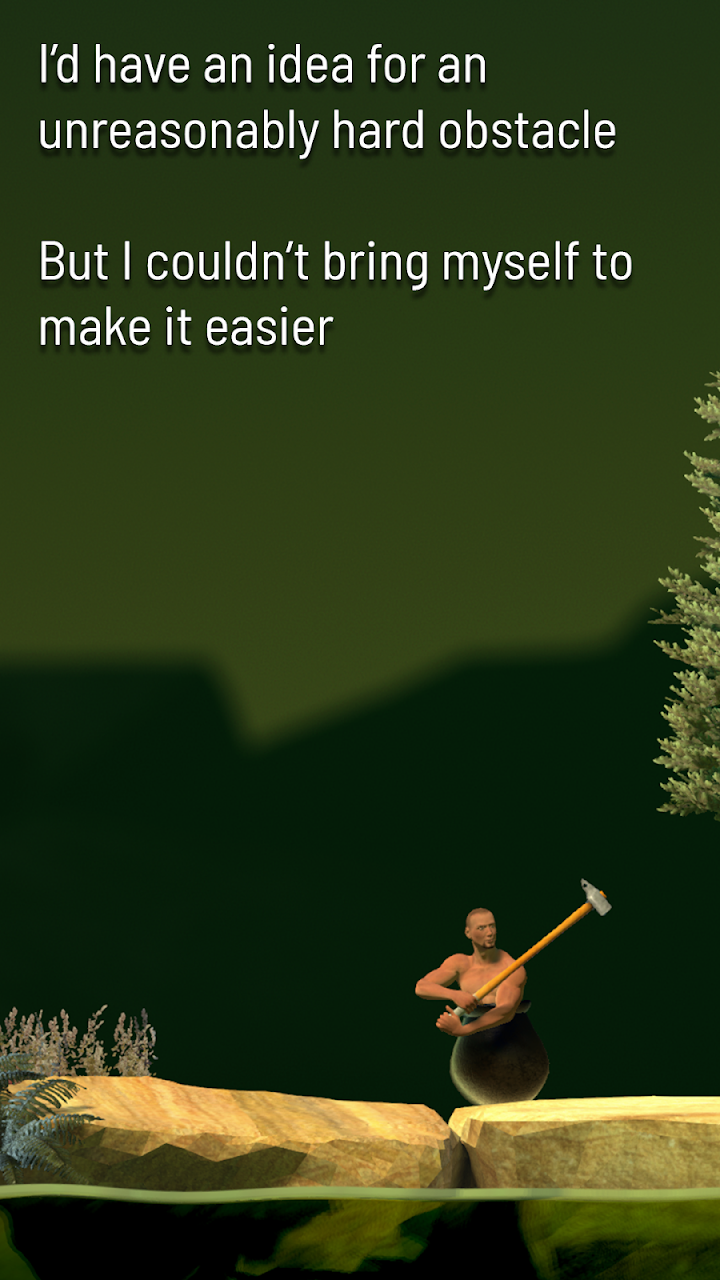
Getting Over It has no checkpoints. There is no save-scumming, no difficulty setting and no accessibility option that removes the fall risk. The mountain is a continuous vertical space, and a slip near the top can send you back to terrain you cleared hours ago.
This is the design, not an oversight, and Foddy has been explicit about the intent: the game is about learning to manage frustration, to slow down when you are close to a goal, and to accept that progress is not permanent unless you are careful. The narration reinforces this. When you fall, the game does not mock you. It talks to you, quietly, about the situation you are in.
That framing is why the game has a following beyond its difficulty. It is not a rage game in the “broken controller” sense. It is a game about composure, and the mountain is a machine for testing whether you can stay composed when the stakes rise. Players who approach it as a test of temperament tend to enjoy it more than players who approach it as a test of reflex.
Length, Reward and the Ending
The store copy gives a median playtest time of 5 hours and jokes that the mean was closer to infinity. Both numbers are honest. Skilled players who already know the route finish in a couple of hours. First-time players without prior knowledge routinely take much longer, and the variance is enormous because it is driven by how often you fall.
There is a reward at the top. It is deliberately understated, and the game's own description calls it “a wonderful reward” with a straight face. Reaching the summit is not the point of the game; the climb is. But the ending is worth seeing, and it is not a trick or a troll — it resolves the game's framing in a way that most players find satisfying.
There is no replay incentive beyond personal improvement and the speedrunning community, which is small but real. The game's longevity comes from mastery, not from content.
Beginner Tips That Actually Help
- Slow down near the top. This is the single most important piece of advice. The vast majority of catastrophic falls happen when a player is close to a goal and starts rushing. Deliberate, small movements are always faster than a fall and a re-climb.
- Learn the pogo first. A vertical hammer plant that lets you hop is the foundation technique. Practise it on flat ground before you need it on a ledge.
- Small inputs, not big ones. The flick is a small motion. Beginners swing the hammer wildly and lose control. Short, precise movements give you far more control over the result.
- Set the hammer before you commit. Position the head deliberately on a surface, then move. Do not swing and hope.
- Do not chase a lost item. If something you were carrying falls, let it go. The climb back is not worth the item.
- Take a break after a big fall. Playing angry is how you fall again immediately. The game is a composure test, and stepping away is a legitimate strategy.
- Use the narrator. The commentary is not just flavour — it is signposting. What he talks about often correlates with what the next section expects of you.
- Play on a tablet or with a controller if you have either. On mobile, this is the difference between a hard game and a demoralising one.
Pros and Cons
| Pros | Cons |
|---|---|
| One of the most distinctive physics systems in any game | Touch controls make precision dramatically harder |
| Genuinely well-written narration that earns its place | No checkpoints; falls can cost hours |
| Premium pricing with no ads, IAP or timers | No difficulty or accessibility options |
| Small install, runs smoothly on modest hardware | Small phone screens worsen occlusion and precision |
| Mastery is real and visible; skill transfers between sessions | Playtime variance is extreme; some players stall for good |
| Works offline; a complete, finite experience | Little replay value once you have finished it |
Who Should Play It
Try it if you enjoy games where the challenge is legible, the failure is your own, and the reward is mastery rather than story. It is especially good for players who like physics sandboxes, speedrunning, or games that treat frustration as a subject rather than an accident. If you have a controller or a tablet, the mobile version is a legitimate way to play.
Skip it if you only have a phone and you know that imprecise input will make you angry rather than determined. It is also worth skipping if you need checkpoints, difficulty options, or a game that respects your time in the conventional sense — Getting Over It is explicitly not that game, and it says so in its own store description. Players who want the experience but not the punishment should probably watch a playthrough instead.
Frequently Asked Questions
Is Getting Over It free?
No. It is a premium one-time purchase with no adverts, no in-app purchases and no energy timers. Check the current store listing for the price in your region, as it varies.
Is the mobile version the same as the PC version?
The content, physics and narration are the same. The difference is input: the PC version uses a mouse, and the mobile version uses touch controls, which make the precision the game demands harder to achieve. Controller support depends on the build and region — check the listing before buying.
How long does it take to finish?
The developer's playtesters had a median time of about 5 hours, with enormous variance. Skilled players who know the route finish faster; first-time players without prior knowledge can take considerably longer. There is no checkpoint system, so time lost to falls is a major factor.
Can I lose all my progress?
Yes. There are no checkpoints and no saves mid-climb. A fall can send you back to terrain you cleared much earlier. This is intentional design, not a bug.
Is there a difficulty setting or accessibility option?
No. The game has no difficulty settings and no option to remove the fall risk. That is central to its design.
Does it work offline?
Yes. The game is fully playable without an internet connection once installed.
Is there a reward at the top?
Yes. The game has an ending, and it is deliberately understated but genuine. The developer describes it as “a wonderful reward” for players who reach the summit.
Who is Bennett Foddy?
Bennett Foddy is a game designer and academic, known for games that explore physics, difficulty and player frustration. Getting Over It is one of his best-known works, alongside QWOP and other experimental titles.
Availability and Pricing
Getting Over It with Bennett Foddy is developed by Bennett Foddy and is available on Android and iOS as a premium one-time purchase. Pricing varies by region and the game is occasionally discounted. There are no in-app purchases or adverts.
Before buying, check the current store listing for the price in your region, device compatibility, and whether controller support is available in your build. If precision input is a concern, consider playing on a tablet rather than a phone.
Developer: Bennett Foddy
Disclosure: NovaRunway is an independent app and game discovery site. We are not affiliated with, endorsed by, or sponsored by Bennett Foddy or any Getting Over It publisher. All trademarks and intellectual property belong to their respective owners. This article reflects our editorial assessment based on the current mobile build and publicly available information, and is provided for informational purposes. Pricing, controller support and feature availability may change — verify with the official store listing before purchasing.