- Developer
- Arnold Rauers
- Installs
- 1M+
- Downloads
- 0
- Views
- 2
- Updated
- Nov 6, 2026
Screenshots
About Card Crawl
Card Crawl: The Solitaire Game That Becomes a Card-Counting Game
Updated November 2026 · Written by the NovaRunway editorial team
Quick Verdict
Card Crawl is one of the most elegant designs on Android, and it is deceptively small. You are dealt cards from a 54-card dungeon deck — monsters, items, potions, gold — and you have to survive the whole deck with a four-slot inventory and a health bar. A run takes two or three minutes. What turns it from a curiosity into a game you keep installed is that the deck is fixed and knowable. After a dozen runs you start counting: how many Ogres are left, whether the next card can be a potion, whether you can afford to take that hit. That is the entire skill ceiling, and it is a very good one. The metagame is the ability cards — five per run, chosen from a pool of 36 unlocked with in-game gold — which function as a small deckbuilder wrapped around the solitaire core. It is premium, with no ads and no in-app purchases, which makes it an easy recommendation. The caveat is that it is a small game, and the RNG will occasionally hand you an unwinnable deal.
What Card Crawl Actually Is
Card Crawl is a solitaire-style dungeon crawler from Tinytouchtales, the studio of designer Arnold Rauers. It was released in 2015 and has been quietly maintained ever since, which is unusual for a premium mobile game of that era.
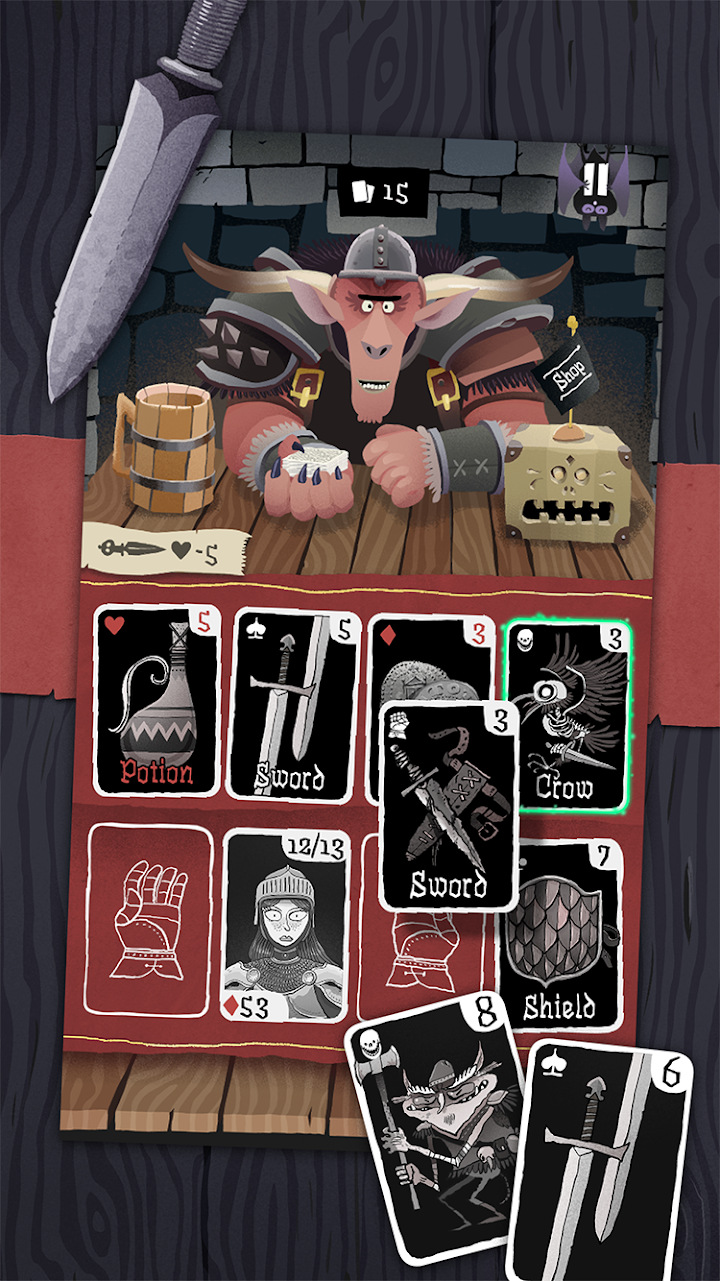
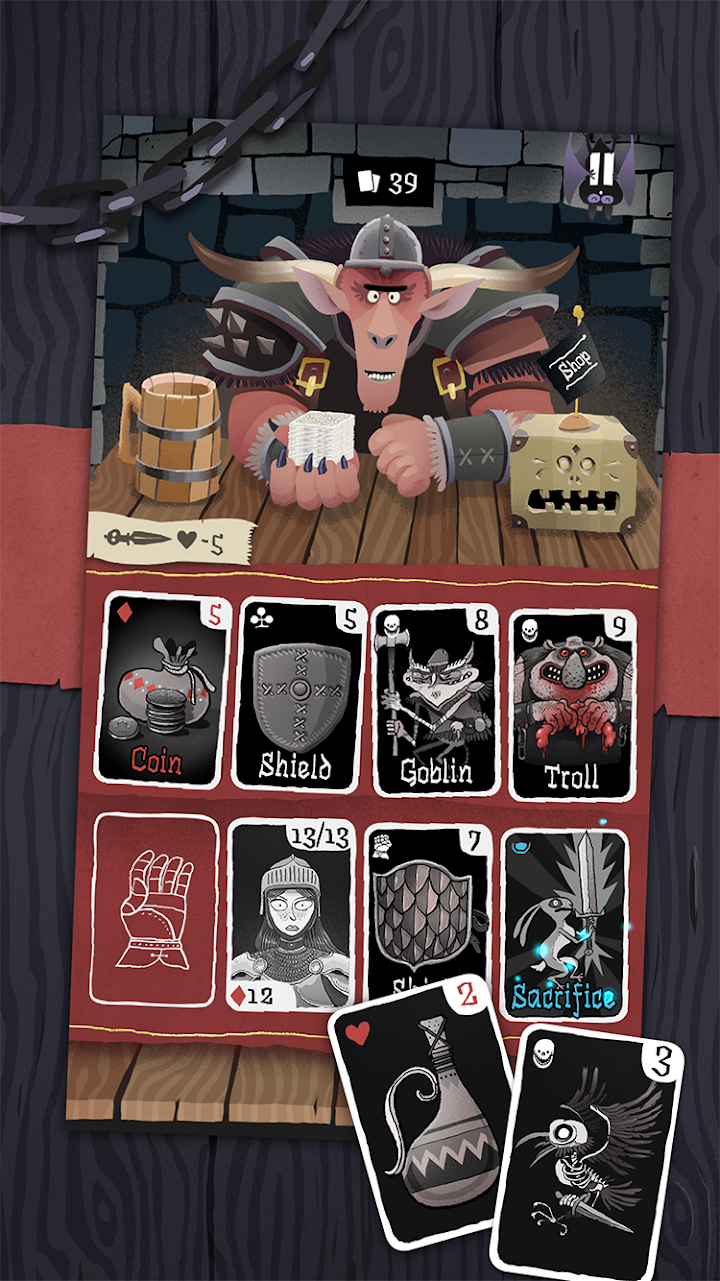
The premise is not a dungeon crawl in any conventional sense. There is no map, no movement, no exploration. You are dealt four cards from a 54-card dungeon deck, and you resolve them one at a time: monsters must be fought or avoided, items can be equipped or sold, potions heal, gold accumulates. Your inventory has four slots, and your health is the only other resource that matters.
Clear all 54 cards and you have finished the dungeon. Die first and you have not. That is the whole structure.
The card art is hand-drawn and slightly grotesque in a storybook way — ogres, imps, swords, shields, mouldy bread. It is not a game that tries to look expensive. It tries to look like a deck of cards, and it succeeds.
The Core Loop: Four Slots and Fifty-Four Cards
The rules take about ninety seconds to learn and considerably longer to master. On each turn you deal with one of four cards:
- Monsters — you must either fight them, which costs health and deals damage based on your equipped weapon, or discard them by spending a coin.
- Items — weapons, shields and armour that occupy inventory slots and modify your combat numbers.
- Potions — healing, which is scarce and therefore precious.
- Gold — the currency that lets you discard bad cards and buy your way out of trouble.
The constraint is the four inventory slots. You cannot hoard. Every item you keep is a slot you cannot use for something better, and every monster you cannot kill is a coin you have to spend. The game is not about finding the strongest card; it is about managing a hand that is always slightly too full.
That is where the counting comes in. Because the deck is fixed at 54 cards and you see every card that has been played, you can track what remains. How many Ogres are still in there. Whether the potions are exhausted. Whether the last few cards are likely to be gold. Players who count do measurably better than players who do not, and the gap is the game's real difficulty curve.
Ability Cards: The Metagame That Keeps It Alive
If the 54-card deck is the game, the ability cards are the reason it stays interesting.
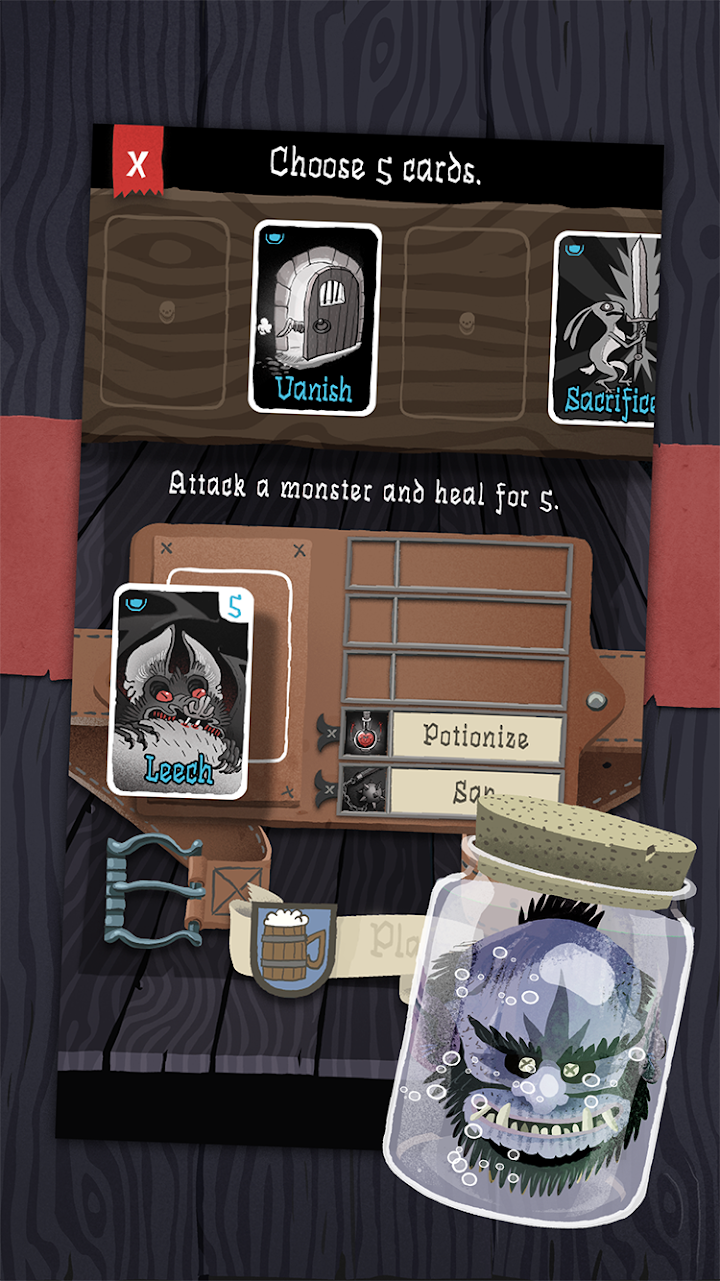
Before each run you select five ability cards from a pool you unlock with gold earned in play. There are 36 in total — 35 unlockable plus the starting set — and they are not cosmetic. They change the rules of the run: modifying how monsters resolve, altering your inventory, converting gold into health, and so on.
That is a mini deckbuilder wrapped around a solitaire game. Choosing five from thirty-six is a real decision, and the combinations matter more than any individual card. Some abilities are strong early and useless late; some are only worth taking if you plan to play defensively. Because the underlying deck is fixed, the ability loadout is the only variable you control before the deal — and therefore the only thing that lets you approach a familiar deck in an unfamiliar way.
It is also a fair progression system. Gold is earned in play, not bought. There is nothing to purchase with real money once you own the game.
The Four Game Modes
The store text lists four modes, and they are genuinely different rather than reskins.
| Mode | What it is | Best for |
|---|---|---|
| Normal | The standard 54-card run with your chosen ability cards | Learning the deck and the counting |
| Constructed | Build a custom dungeon deck and play against it | Players who want to test specific ability combinations |
| Daily | One shared dungeon per day, same deal for everyone | Leaderboard comparison and a reason to open the app |
| Delve | A longer, progressive run added after launch | The deepest single-player experience in the game |
Delve is the important one, and it is the mode the original store listing predates. It takes the three-minute run and stretches it into a longer session with progression between encounters, which addresses the main criticism of the base game — that it is too small. If you bounce off Normal after an hour, Delve is where to go next.
Constructed is the mode for players who want to break the game. The dungeon deck editor lets you build custom decks from the card pool and share them with other players via codes, which is a feature most mobile games would have monetised. Here it is just included.
Daily is the one that keeps the app on your home screen. One deal, shared by everyone, with leaderboard comparison through Google Play. It takes three minutes and it is the best possible use of the game's structure.
How It Plays on a Phone
Card Crawl is a portrait, one-thumb game, and it is designed for exactly the situation the store text describes: waiting in line, commuting, killing five minutes.
The good: there is no virtual stick, no camera, no gesture to learn. You tap a card to act on it, drag to arrange your inventory, and tap to resolve. The interface is uncluttered and readable at phone size, and the game is playable entirely with one hand. Performance is irrelevant because the game is 2D cards — it runs on anything, loads instantly, and works fully offline.
The caveat: there is no landscape mode worth using and no controller support, which is fine for what it is. The bigger practical issue is that the game is small. A run is three minutes, and after you have memorised the 54-card deck, some of the discovery is gone. The ability cards and Delve mode are what extend the life beyond that point.
On a tablet the cards are large and the whole thing feels more like a physical solitaire set, which suits it. But the phone version is not compromised — it is the intended form factor.
Premium Pricing, No Ads, No Purchases
This deserves its own section because it is increasingly rare.
Card Crawl is a paid download — around $2.99 on Google Play, with regional variation — and it has no adverts and no in-app purchases. The gold you earn in play is the only currency, and it unlocks ability cards and nothing else. There is no energy system, no timers, no gems, no loot boxes and no battle pass.
That means the game you buy is the game you get, permanently, offline. For a three-minute game you will open dozens of times, it is one of the clearer value propositions in the premium mobile category. It also means there is no design incentive to make the game frustrating in order to sell you relief, which is exactly the problem with most of the genre.
The trade-off is that there is no ongoing content pipeline. Tinytouchtales has kept the game working, but it is a finished product rather than a live service. If you want the studio's newer take on the idea, Card Crawl Adventure is the follow-up, and it is a larger and more ambitious game — but it is also a different design, and some players prefer the original's austerity.
Where It Falls Short
- RNG can end a run before it starts. A deal that stacks monsters before you find a weapon is simply lost. Counting mitigates this but does not remove it.
- The base deck is small and learnable. Once you know all 54 cards, the discovery phase is over permanently. Delve and Constructed are the answer, but they are still built on the same deck.
- Three minutes is both the appeal and the limit. It is perfect for a queue and unsatisfying if you want a long session. Delve helps; it does not transform it.
- Presentation is deliberately plain. The hand-drawn art is charming but the game does not look expensive, and players who want spectacle will be unmoved.
- No ongoing updates. It is a finished game, not a growing one.
Beginner Tips for Card Crawl
- Count the Ogres. The high-damage monsters are the ones that kill you. Track how many have appeared; when they are gone, you can play more aggressively.
- Do not hoard items. Four slots is the whole constraint. An item you are not using is blocking a slot you will want next turn.
- Spend gold to discard, not to survive. Discarding a bad card early is usually better than saving coins for an emergency you may never reach.
- Pick abilities around one plan. Five abilities that support a single strategy beat five good abilities that do not combine.
- Play the Daily every day. It is one deal, shared by everyone, and it is the fastest way to learn what good and bad deals look like.
- Move to Delve once Normal feels solved. The longer mode is where the game's depth actually lives, and it is what keeps it installed.
- Build a Constructed deck to test an idea. The deck editor is not just for sharing — it is a lab for figuring out whether an ability combination works before you commit to it in a real run.
- Accept the losses. Some deals are unwinnable. Recognising a dead run early and restarting costs you ten seconds; playing it out costs you three minutes.
Pros and Cons
| Pros | Cons |
|---|---|
| Elegant solitaire design that becomes a counting game | RNG can produce unwinnable deals |
| Two-to-three-minute runs, ideal for short sessions | Base deck is small and fully learnable |
| Premium: no ads, no IAP, no energy, no timers | Deliberately plain presentation |
| 36 ability cards create a real mini deckbuilder | No ongoing content updates |
| Four modes including Delve and Daily | Delve is the only answer to the length problem |
| Dungeon deck editor with shareable codes | No landscape or controller support |
| Portrait, one-thumb, fully offline | Three minutes may feel too small for some |
Who Should Play It
Buy it if you want a small, sharp, premium game you can play one-handed in a queue and still be thinking about an hour later. It is especially good for players who like solitaire, roguelites with tight scope, or games where the skill is memory and arithmetic rather than reflexes. If you have ever enjoyed counting cards in a real deck, this is the digital version of that pleasure.
Skip it if you need a game that grows. Card Crawl is finite, and once you have solved the deck and unlocked the abilities, the ceiling is visible. It is also worth skipping if random losses make you put a game down — some deals are simply lost, and no amount of skill fixes them.
Consider Card Crawl Adventure instead if you want a bigger, more narrative take on the same studio's ideas. The original is the purer design; the follow-up is the larger one. Both are worth owning, and they do not replace each other.
Frequently Asked Questions
Is Card Crawl free?
No. It is a premium paid download, typically around $2.99 depending on region. There are no adverts and no in-app purchases once you own it.
How long is a game?
A standard run takes two to three minutes. Delve mode is longer, and Constructed runs vary with the deck you build.
What are ability cards?
A pool of 36 cards, of which you select five before each run. They modify the rules of that run and function as a small deckbuilder. They are unlocked with gold earned in play, not purchased with real money.
What is Delve mode?
A longer, progressive mode added after launch that extends the three-minute run into a deeper session with progression between encounters. It is the game's answer to the “too short” criticism.
Does it work offline?
Yes. The game is fully playable without a connection. Leaderboards and daily comparison require one.
Is there a daily challenge?
Yes. The Daily mode gives every player the same deal, with leaderboard comparison through Google Play.
Can I build my own decks?
Yes. The dungeon deck editor lets you construct custom decks from the card pool and share them with other players via codes.
Is it the same as Card Crawl Adventure?
No. Card Crawl Adventure is a later, larger game from the same studio. It shares the card-game DNA but is a different design. The original is smaller, purer and fully premium.
What Android version do I need?
The requirement is modest by modern standards, and the game runs on a wide range of devices including older hardware. Check the live store listing for the current minimum, as the store description is out of date.
Is it suitable for children?
The art is mildly grotesque — ogres and imps — but non-violent in any realistic sense, and the rules are simple enough to learn. It is a good game for teaching resource management. There are no ads or purchases to worry about.
Availability and Pricing
Card Crawl is developed by Tinytouchtales (Arnold Rauers). It is a premium one-time purchase on Android, typically around $2.99 with regional variation, and contains no adverts or in-app purchases. It plays offline and receives occasional compatibility updates rather than content updates.
Before buying, check the current store listing for the price in your region and the current Android version requirement, since the store description predates several updates.
Official site: cardcrawl.com
Developer: Tinytouchtales
Disclosure: NovaRunway is an independent app and game discovery site. We are not affiliated with, endorsed by, or sponsored by Tinytouchtales or any Card Crawl publisher. All trademarks and intellectual property belong to their respective owners. This article reflects our editorial assessment based on the current Android build and publicly available information, and is provided for informational purposes. Pricing, modes and technical requirements may change — verify with the official store listing before purchasing.